Friday, 8 February 2013

Growing herbs in a restricted space


The Secret Garden Club meets on Sunday to discuss herbs and medicinal plants. We'll look at the ways in which herbs have been used to enhance food over centuries and also how, before the advent of modern medical science, the herb garden was also in effect, a family's medicine cabinet.

We also have a guest speaker: Elke de Wit created B-Amazing, her own natural skincare range centred on the amazing properties of beeswax. She uses herbs extensively in the B-Amazing range and will be explaining how essential oils are extracted from herbs to use in her face creams.

We've also got some ideas up our sleeve (almost literally!) for growing herbs when you don't have much in the way of outdoor space, maybe just a patio, a balcony, or just a windowsill - including the return of the Secret Garden Club's ingenious vertical garden and how to set this up. 


All this and a themed tea created and prepared by MsMarmiteLover - book your tickets for Sunday here.

Tuesday, 29 January 2013

Smokers' paradise

In our third afternoon workshop on smoking, the Secret Garden Club used three different food smoking techniques to demonstrate a wide variety of foods which can benefit from this time-honoured method of preparing and flavouring food.

We started with tea-smoking, a method using the smoke from heated tea leaves to infuse food with a delicate flavour. Then we moved outdoors, on an unseasonably bright winter's day, to hot-smoke vegetables, tofu and halloumi cheese. Finally we turned our intention to our tried and tested home-built cold smoker, made without any specialist equipment, and with no engineering or woodworking skills required.

Further details on smoking generally and the set-ups required for the three different techniques can be found on this blog here (lots of detail on creating a cold smoker) and here (which includes info on different heat sources for cold smoking). Below I've summarised the techniques and give recipes for the food we smoked on the day.

Tea-smoked food

This is a good way to smoke foods quickly and can be done on a conventional hob, although it’s difficult to do without setting off your smoke alarm. I would advise opening all windows and doors before you start.

Tea-smoking mixture comprises loose leaf tea, raw long grain rice and brown sugar. American measuring cups are a boon here, as you need equal quantities of each by volume, thus to smoke food in a 20cm pan, you'll need:

½ cup tea leaves (or 30g if you don't have cups). Use plain black tea, or Lapsang Souchong. Some people like Earl Grey in smoking mixtures, which I find a bit too floral.

½ cup raw long grain rice (or 75g)
½ cup Demerara sugar (or 75g)

Tea-smoked trout fillets
3 trout fillets, preferably from organic or wild fish
1 quantity of tea-smoking mixture as above

A 20cm pan with a steamer basket and a tight-fitting lid.

Cut a square of foil slightly larger than the diameter of your pan and line the bottom of the pan to form a kind of pouch or foil dish within it. Mix the sugar, rice and tea leaves together well and pour into the foil pouch, taking care not to spill over on to the pan surface itself.

Fit the steamer basket and set the pan on a high heat. You should start to see wisps of smoke within 10 minutes. Lay the trout fillets in the steamer basket, trying to keep them to a single layer as much as possible. Put the lid on the steamer basket, and turn the heat down slightly, so that you get a steady stream of smoke feeding into the basket holding the fillets.

Depending on the thickness of the fillets and how well done you like your fish, they will be cooked and ready in 10-20 minutes. Lift the lid cautiously after about seven minutes to see how they're getting on and check regularly after that.


Hot-smoked food
Hot-smoking is usually done by heating up wood chips until they give off smoke, which comes into direct contact with the food. Because the environment is hot, the food cooks as well as being smoked.

Note, when smoking with any kind of wood, it is vitally important that the wood is raw, and untreated. Any sort of treatment, coating, glue or varnish will give off potentially toxic fumes when smoked - NOT what you want coating your food. If the wood you want to use has been cut with a chainsaw, beware - there could easily be oil residues on the wood from the chainsaw. It's highly satisfying to use wood that you have chopped or sourced yourself, but you must be 100% certain that the wood is free of any chemicals. 


Smoked marinaded tofu
Marinade:
3 tbsp soy sauce
3 tbsp maple syrup
3 tbsp olive oil
1 teasp sesame oil
2 teasp Dijon mustard
(this is based on the tofu marinade used at the last smoking workshop in March 2012, but I've amended the recipe slightly to give a fuller, more robust flavour.)

1 carton firm tofu, sliced around 4-5mm thick

In the morning, mix all the marinade ingredients together in a shallow dish. Slide the tofu slices in, cover and marinade in the fridge for 4 hours or more.

When the hot smoker is ready, lift the tofu pieces on to a piece of foil on the rack and hot-smoke for 30 minutes. Some guests felt the smoky flavour of the tofu was quite strong - you can experiment by smoking for 15 minutes, say, and then checking whether the flavour is right for you.

Smoked halloumi
Halloumi is a Cypriot cheese with a firm texture and mild flavour. It has such a high melting point that it can be fried, grilled - or hot-smoked.
If you cut a block of halloumi into slices 5-10mm thick, and hot-smoke these for 25-30 minutes, they make a delicious addition to a red pepper or tomato salad.


Cold-smoked food

Smoked semi-dried tomatoes

Before going on to the cold smoker, the tomatoes were slow-roasted in the oven at 130 degrees for three hours. I would love to call them smoked sun-dried tomatoes, but sun is in rather short supply at the moment, so semi-dried in the oven it has to be.

MsMarmiteLover explains more about smoking tomatoes in her post here.


Smoked camembert
Take one whole camembert, not overripe. Place on a square of foil on the smoking rack and cold-smoke for about 6 hours.
To let the flavours develop through the cheese, remove from the smoker and wrap in foil or cling film. Place in the fridge for 3-4 days before returning to room temperature and letting the cheese ripen fully.

Smoked quail's eggs


Put the quail's eggs in a pan, cover with cold water and bring steadily to the boil over a medium heat. Boil gently for 4 minutes - they will be cooked all the way through. Plunge the eggs into cold water to stop the cooking process, then store in the fridge until you're ready to smoke them.

Once the cold smoker is set up, peel them and lay on a strip of foil on the smoking rack. Smoke for 4-6 hours - the surface of the eggs should be just beginning to brown, like a light tan. Remove and serve with salt for dipping the eggs into - we also smoked the salt (spread thinly on a plate and cold-smoked for 2 hours) at the Secret Garden Club.

Smoked salmon
Salmon is usually split into two sides with the backbone removed, or cut into fillets before it is smoked. Unless you're an experienced filleter, it's probably to buy the salmon ready-cut or get the fishmonger to do it. Before it can be cold-smoked, salmon also needs to be cured, ie, steeped in sugar and salt for 18-24 hours before you put it on the smoker. This curing process helps to preserve the salmon, inhibiting the possible multiplication of bacteria that may otherwise take place during the smoking process.

Curing usually means covering both sides of your fillets with a mix of equal parts of sugar and salt, plus flavourings such as herbs - dill is a classic ingredient in salmon cure. Cover the bottom of a baking tray with half the salt/sugar mix, strew with the herbs and lay the fillets, skin side down over the mixture. Now spread the rest of the salt/sugar over the exposed salmon flesh until it's all covered. Wrap the salmon and tray tightly with cling film and place on a shelf in your fridge. You also need to weigh down the salmon - I placed full milk and juice cartons on top of the salmon while it was curing.

Slender fillets will probably need only 18 hours in the cure mixture. For a thicker side of salmon keep the salmon curing the fridge for 24 hours or more. After 24 hours you can also scrape away the used salt/sugar and replace with another batch.

At the end of the curing process you'll find the baking tray full of liquid. Pour this off carefully, then rinse and dry the salmon. You should find the fillets are less pink, more golden in colour and feel firmer or stiffer to the touch.

Finally leave the salmon fillets to dry out slightly before putting them on the cold smoker. We smoked our salmon in a mix of oak and beech wood chippings for a total of 12 hours.

Monday, 28 January 2013

Recipes: smoked tomatoes and smoked caramel


Preserve them in olive oil.
Yesterday the sun shone and The Secret Garden Club showed how to hot smoke, cold smoke and smoke with tea. In addition to things we've previously smoked (tofu, salmon, trout, peppers, cheese, garlic, salt), we added:
Tiny smoked waxy Cypriot potatoes in their skins (with sour cream)
Smoked 'sun-dried' tomatoes
Smoked vodka from Chase with smoked lemon juice
Smoked halloumi (in a red pepper salad)
Smoked camembert, heated up like fondu and served with freshly baked sesame pitta breads

Semi-dried and dried

Smoked cherry tomatoes recipe:

The tomatoes can be dried on a low oven or in the simmering oven of the Aga. I often find sun-dried tomatoes in the shops to be too tough, reminiscent of rubbery ears. I prefer a semi-dried tomato.
But ooh the taste! So intense, I don't think they will last long in my house. Too good. I bottled them in olive oil.

1 kilo cherry tomatoes
Sea salt
White caster sugar

Halve the tomatoes and lay them, cut side up, on a baking tray. Dry on a low heat (100-150Âșc) for around four hours.
I sprinkled them with sea salt and white sugar (winter tomatoes haven't had much sun to bring out their natural sweetness)
Then lay the tomatoes on a bed of foil and cold smoke for 5 to 8 hours.
Put the tomatoes in a jam jar and cover with good olive oil.
Eat them in salads, on toast, out of the jar! Give as gifts!


Smoked caramel

200g of sugar (I used white caster sugar but use whatever you've got)
200ml of double cream
75g of butter
1 tablespoon of good sea salt
Slug of Bourbon/ Jack Daniels/whisky/Drambuie (optional)


Put the sugar in a sheet of foil. Tuck up the sides so that the sugar doesn't fall out but leave the top open. Put this in the cold smoker for about four hours.
Then using the dry method of caramel making, pour the sugar into a heavy bottomed saucepan and let it melt. Do not stir. Brush around the inside of the pan with a pastry brush and water to prevent crystallisation of the caramel or put a tight fitting lid on (mind you have it on a low heat or it'll boil over) which has a similar effect.
Once the sugar has begun to melt, move the pan around, shifting the sugar. But don't stir.
When the sugar is all melted, add the butter and stir in the cream. Keep stirring now.
Add the salt.
Add some alcohol if you like.
Your smoked caramel will taste even more gorgeous. Pour on icecream, on meringues, use in hot chocolate.


I used a ProQ smoker kit. This is ok for smoking small things/thin things but isn't stable enough for whole sides of salmon. I find it cooks the salmon in parts.
ProQ smoker kit which you can put in an existing BBQ and tomatoes waiting to be smoked

The next post Zia will tell you how to tea smoke and give more cold smoking recipes! 

Friday, 25 January 2013

The big smoke

This Sunday will be our third smoking workshop at the Secret Garden Club - it's always a popular topic, perhaps because it is so satisfying to create your own smoked food from scratch. It's also surprisingly easy, as we demonstrate, to set up your own smoker in the garden or on a patio.

One of the things that is most enjoyable about our Learn To Smoke sessions is experimenting with new flavours. We have our traditional favourites - on Sunday we'll be tea-smoking trout fillets and the side of salmon is already in the cold smoker - but it's always fun to try out some more unusual flavours.

This time, we're trying out smoked quail's eggs, using a method recommended to me, and also smoked semi-dried tomatoes - I'd love to call them sun-dried, but that would be fairly incredible at this time of year.


There'll be plenty more smoked foods to taste and talk about on Sunday and we still have a few places left at £60 which includes the workshop, demonstration and supper - book your ticket here if you'd like to come and join us.

Sunday, 23 December 2012

Oranges and lemons


Citrus are not tropical plants and will grow naturally in fairly specific climatic conditions. The southern Mediterranean is in many ways an ideal climate as is parts of Asia around the Himalayas and south-east Asia where they have grown for thousands of years. They like to be warm during the day and cool at night, warm in summer and cold in winter – without any frost. A few modern citrus hybrids will withstand some light frost, but oranges in particular like warmer temperatures.

Citrus fruits came to Europe from Asia in numbers in the early middle ages, although there are reports of lemons being grown in Italy in the third century AD, and also in the middle east after around 700 AD. 

Lemons arrived in the Caribbean with Christopher Columbus on his second voyage west, and spread slowly through the islands and on to the north American mainland until mass cultivation began in Florida and California in the early 1800s.

These days most citrus grows in Italy, Spain, Greece, Turkey, Cyprus, Lebanon, South Africa and Australia. Australia has native citrus varieties which have evolved in isolation away from the trading routes of Asia, Europe and most recently the Americas. Citrus grows rather well in hilly rather than mountainous terrain. High enough for it to get cold at night and in winter, but not high enough for ice and snow. 

In northern Europe, growing oranges and lemons in glasshouses became very popular for the wealthy from the 1600s onwards. It was only the rich who could afford to build big enough glasshouses to house their trees and to keep the servants who would haul the trees, planted in huge wooden crates with handles, outside in late spring and back in October before the first frosts struck.

As the vast majority of citrus plants are non-hardy, it’s a mistake to think that any garden or patio in the UK is sheltered enough to grow them outside on a permanent basis. So grow them in pots, and keep them outdoors in summer, but bring them in in winter. 

The citrus plants we have at the Secret Garden Club are:
  • 2 different types of lemon, a Eureka, and a Meyer lemon. Meyer lemons can withstand the occasional low temperature. That still means you bring it in overwinter.
  • A kaffir lime - the aromatic leaves are used in Thai cuisine, as is the zest of the knobbly fruits.
  • A grapefruit tree – this particular tree is relatively new to me. I don’t even know if this is the sort of size of fruit I should expect. 
  • A calamondin – another example of a relatively hardy citrus. There are always plenty of these little fruits on the tree – they are startlingly tart to taste, but make a fantastic lime pickle (calamondin pickle), great in a gin and tonic, and I’m told, make very good marmalade.
  • A kumquat tree.This has already produced a heavy crop of ripe fruit and a second crop is developing now.
You might be surprised to know that these are all hybridised types of citrus, except possibly the kumquat, which is odd as until a few years ago, the kumquat was thought not to be a citrus at all but a more distant relation.


Citrus fruits for tasting at the Secret Garden Club. Clockwise from top left: pomelo, pink grapefruit, limettas (sweet lemons), clementines, yellow limes, green Mexican limes, oranges, lemons, kumquats
Origins and hybridisation
The ancestry of citrus plants would keep several series of Who Do You Think You Are going for months. There are over 300 different varieties, with many hybrids, either varieties occurring naturally, or cultivars which have been deliberately crossed by horticulturists. In the last few years botanists have been able to use DNA testing to ascertain precisely how some varieties have occurred and which plants are their  ‘parents’, as it were. Before DNA testing, they had to look at external characteristics, habitat, etc.

Keeping track of citrus is complex, but if you’re interested, there is a fantastically comprehensive website called Citrus Pages, which attempts to catalogue all varieties of citrus, with photos and descriptions. Although it's quite scholarly in places, it's also immensely readable, and if you've ever wondered how a lime is related to a grapefruit, or just how many varieties of tangerine there might be, this is the place to visit.

I have also attempted to show the relationships between the common varieties you find in UK shops in this diagram here. Looks complicated? It’s actually over-simplified and any botanist would probably look at it and say, “We-e-e-ell …”

All the evidence suggests that there are three ‘original’ citrus types which have hybridised and crossed to create all the others: the citrons, the mandarins and the pomelos.

Citrons (Citrus medica)
Citron is the oldest known variety of citrus, and were originally used as perfume and a insecticide. Citron seeds have been found in archaeological excavations in Babylon (now Iraq), in ruins which date back to 4000 B.C. They’re known to have been cultivated in the middle east since around 700BC.

Lemons, limes and bergamots all have a citron variety as one of their 'parents'.

Mandarins (Citrus reticulata)
Mandarins originate from China and Japan (hence two of the names to describe mandarin varieties – mandarin and Satsuma – and were brought over to England at the beginning of the 19th century. During the course of 1800s they were introduced into Italy and other Mediterranean countries and into the USA (a variation from the more conventional wetsward Mediterranean to GB route).

Satsumas, tangerines and clementines are all varieties of mandarin – clementines a hybrid between mandarins and sweet oranges. Other hybrids with mandarins as a parent include minneolas, tangelos, ortaniques and other less well-known varieties.

Pomelos (Citrus maxima)
You mainly see pomelos in Asian stores rather than supermarkets. It’s a deceptively big fruit, as the peel and pith are often quite thick; the taste is like a milder, less acidic - and much less juicy - version of the grapefruit. 
Pomelos originate from south east Asia, mainly Malaysia. These days it is also grown in Fiji and other Pacific islands but although it was introduced into the Caribbean and the Americas as were other citrus it has never really caught on there.
Pomelo hybrids include grapefruit and sour and sweet oranges (pomelo x mandarin) - the sour varieties inheriting more pomelo features, the sweet versions with more mandarin characteristics. 
How to grow a citrus plant
You can raise a plant from sowing citrus pips fairly easily. With oranges and lemons in particular, if you sow in good compost and keep the pot warm, you should get several seedlings from a single pip. If you’re just after an ornamental tree, then that’s a highly cost-effective way to do it.

But if you want fruit I wouldn’t recommend sowing a pip.  If your seedling grows true to type (it may well do so, but there’s no guarantee), it will take about 10 years before it produces any fruit. If you want to guarantee fruit, buy a named cultivar from a reputable dealer. This will be a grafted plant, where the top of one plant is melded on to the rootstock of another – grafted citrus will fruit much earlier.

Garden centres will often get deliveries of citrus trees around now, just before Christmas – because they make good Christmas presents, and then again in spring at the start of the new season. Beware of buying a Christmassy citrus – I’ve seen some unsuitable ones. Oranges, for example, like it warmer than other citrus fruits and their fruit are rarely good to eat unless kept in a proper greenhouse – lemons are more suited to our climate. A table of mandarin plants up at a garden centre near here were being kept in conditions that were too warm and sure enough when I lifted up a pot to take a closer look, all the developing fruit fell off. £40 is a lot to ask for a plant that has just lost all its fruit.
You can buy from a specialist, or an outlet which regularly sells citrus - the Secret Garden Club likes M Lanza in Crews Hill - or you can go online. I've had good experiences with the following:
I also like the look of Global Orange Groves and have spent much time browsing there but haven't bought anything from them yet. If I was going to buy any of their trees, it would be this one, a Citrus medica ‘Fingered’, or Buddha’s Fingers, where the segments of the fruit grow inside out, as it were. Ornamental only!
So, you’ve bought your plant, whether it’s a lemon, a Kaffir lime, or a calamondin, and let’s say you’ve bought it round about now. How to care for it? Citrus plants have very specific care requirements depending on the time of year and all relating to the ideal conditions they would like in the wild. If you’re able to meet these requirements, then you’ll find citrus an easy plant to look after. Otherwise, they can appear to be very fussy. It’s worth working out in advance whether you have a good environment for a citrus plant as they can be expensive to buy – but then, looked after well, they can last a lifetime. 

Standing plants in a moist gravel tray keeps the air around the plant relatively humid 
  • Find a cold room – they like a winter temperature of between 7-13 degrees C, no draughts and with relatively humid air. A light unheated bathroom is your best bet, an unheated spare bedroom the next best. Below 7 degrees, the plant will become dormant and won’t flower. Over 13 degrees, and developing fruit may drop (so may the leaves).
  • Ensuring relatively humid air can be a challenge. One way to increase the ambient moisture around the plant is to create a gravel tray as we have here. Stand the pot on a tray of gravel and keep the gravel moist – don’t let the water come up to the level of the bottom of the pot, though, you don’t want to waterlog it.
  • Another way is to get one of those spray misters and keep it full near the plants. Whenever you go past, give the plants a squirt from the mister.
  • In winter, let the soil in the pot dry out between watering. When you do water, give it a good soak and make sure that any excess water can drain away. Standing plants in the (empty) bath is a good way to do this.
  • Ideally, water with rainwater. (I have to confess I do this in summer, but not winter.)
  • Buy a pot of citrus winter feed – this contains a balance of nutrients that will supplement the nutrients in your soil. Use the feed according to the instructions when you water, or about once every fortnight.
  • Check your plant regularly for signs of pests or disease. We’ll talk about these in more detail, but you can keep plants clean and healthy by getting rid of any problems as soon as they arise and before they take hold.
  • Remove any leaf fall, bud fall straightaway to keep the areas below and around the plants clean and debris free.
  • In springtime, you may well see fruit starting to form – although both lemons and oranges will flower in autumn, winter or spring, so you can get fruit and flowers on the tree at the same time.
  • Once all danger of frost is past, and the night temperature no longer goes below 7 degrees, the plant should go outside. It’s not really a kindness to keep them in. Oranges, however, which like warmer temperatures, may well benefit from being kept in an unheated, well-ventilated greenhouse in summer. Generally, citrus will benefit from the fresh air outside and also the difference in temperature between night and day – the bigger the difference, the juicier the fruit, or so people say. This temperature difference is also what deepens the red colour in a blood orange.
  • Put the plant somewhere light and bright and preferably south facing to make the most of summer warmth. BUT, not in full sun – under another bigger plant would be ideal. Even more important is that it should be sheltered – a light breeze may be welcome, but it won’t like being exposed to wind.
  • Once you see fruit forming, keeping the plant sheltered is even more important, so that the fruit doesn’t drop. If a plant has a lot of immature fruit forming, some fruit drop will be inevitable and not unhealthy.
  • Now switch to a citrus summer feed – this will be one high in nitrogen and feed the plant around once a week.
  • In summer the soil can be kept lightly moist, but never let it become waterlogged – it must always have good drainage. Ideally water with rainwater.
  • If you want to transfer you citrus to a bigger pot, first, desist. Citrus do not need yearly repotting, but will be happy in the same pot for 2-3 years. 
  • When you do repot, you can use a proprietary citrus compost.
Lemons like slightly cooler conditions than oranges or grapefruit - its green fruit will ripen to yellow during the colder winter nights, but it will still be killed off by any frost. Oranges, however, are more of a sub-tropical plant, more suited to the southern Mediterranean than the cool UK, even in summer. Even so, they, like lemons, need a wide difference in temperature between day and night to help ripen the fruit and turn it from green to orange.
This requirement for warm days and cooler nights also partly explains the colouration of blood oranges. Blood oranges are a mutated variety of sweet oranges, and the greater the difference in temperature, the deeper the red colour of the flesh. 
Limes are related to lemons and to papedas, a particular type of ancient wild citrus originating from Asia. The kaffir lime, whose leaves and zest are used in Thai curries, is perhaps the best-known example in the UK of the papeda subgenus.

Pests and problems
The most common pests most likely to attack your citrus plants are scale insects, mealybugs and citrus leafminers. Scale insects look like little brown and white discs (or indeed scales) adhering to the trunks and branches. Mealybugs look like wisps of cotton wool stuck in the crooks between stem and leaf, or on buds. Inside that cotton wool there is a little bug, which will look superficially like a tiny woodlouse has been dusted with talc.


Both of these can be most easily removed with a damp toothbrush. Pinch out any badly affected leaves. 
Leafminer larvae will actually burrow inside the leaves, leaving discoloured trails on the surface. Any damaged leaves should simply be removed from the tree.

Remove scale, mealybug, or leafminers as soon as you see them – operate a zero tolerance policy. If any of these get a hold on your plant they will debilitate it severely.
The other main problem often suffered by citrus trees is the propensity of the leaves to fall off. The most common reason for this is overwatering in winter, when the plants really can be left to dry out a bit. However, draughts, being moved around too much, or being kept too cold, or, more likely in winter, being kept too warm, will also lead to leaf fall.

You can worry less about the fruit that fall off when they are still very tiny. Some fruit drop is inevitable - like airlines overbooking their flights, many types of fruit tree will set far more fruit than the tree can handle.

Tuesday, 18 December 2012

Citrus crafts and gifts for Christmas

Still not got round to finishing (or even starting) your Christmas shopping? We have some quick and easy gift ideas for you, using citrus fruits. This month's Secret Garden Club meeting looked at growing and making use of citrus, including some great ideas for some home-made gifts.

Usually we like to look at how best to cook and eat our produce, but on Sunday, the Secret Garden Club looked at more ornamental and decorative ways of using lemons and oranges. Guests concocted a jar of refreshing lemon bath salts and made a spiced orange pomander, as well as learning how to make Moroccan style preserved lemons.

Lemon bath salts
2 tbsps Epsom salts – available from the chemist
½ tbsp fine sea salt
Zest of two lemons

A clean, airtight jar.

These amounts can be scaled up or down to suit the size of jar and the number of lemons you have. You can also add more lemon zest to make the lemon fragrance even more intense.

Mix all ingredients well. A whisk is a good way to get all the zest incorporated without clumping. Store in an airtight jar and sprinkle as much as liked in your bath for an aromatic, revitalising soak.

Spiced orange pomander
As long ago as mediaeval times people would hang perfumed pomanders up in rooms, or carry them around with them to disguise bad smells – of which there were many in the olden days.

We may not have foul-smelling rooms or bodies these days, but a spiced pomander will still fill a room, or cupboard, with fragrance and will last for years. This combination of orange and spices gives these pomanders a distinctly Christmassy aroma, ideal as gifts at this time of year. 

1 orange
A toothpick (optional)
1 cup cloves
Masking tape
Ribbon

Spice mix:
1tbs ground cinnamon
1tbs gound nutmeg
1tbs ground ginger (dry ginger)
1tbs ground coriander
1 tsp sandalwood powder
Orris root powder is more traditionally used as a preservative and fixative, but quite a few people turn out to be allergic to it, so we used sandalwood powder at the Secret Garden Clubas it’s less likely to cause upset.

Mix the spices together and pile into a paper bag.

Mark out the orange into quarters with the masking tape. (This makes it easier to fix the ribbon later. For less artistic types, like me, it also helps to keep the patterning neat.) If the orange peel is at all hard, make a hole in the orange first with the toothpick, then push a clove into the hole just made. You should cover the whole orange apart from the masking tape – you can choose patterns or arrange the cloves in rows. Don’t pack the cloves together too tightly as the orange will shrink slightly as it dries out. Put the orange in the paper bag with the spices and toss it so that the gaps between the cloves are well covered with spice mix.

Keep the oranges in their paper bag and put somewhere warm and dry – the airing cupboard is ideal. Turn the orange every day or so.  When the orange is hard to the touch, it’s ready - in a week or so. Carefully remove the masking tape and tie a ribbon around the orange so you can hang it up.

Preserved lemons
This is an essential condiment in middle eastern recipes, livening up casseroles, tagines or rice. Although the only two ingredients are salt and lemons, the flavour is surprisingly soft and mellow. It's so simple to make that I feel it hardly counts as a recipe - here's what to do.

6 unwaxed lemons, washed and dried (to fill a 500ml jar)
Sea salt
Making preserved lemons, clockwise from top left: slice five of your lemons into four wedges but don’t cut right through the lemon – leave the wedges attached at the stem end; next, rub the sea salt into the wedges (shown cut all the way through here); bottom right, pack the cut lemons into a wide-necked jar, and sprinkle with a tablespoonful of salt. Juice your last remaining lemon, add the juice to the jar, and top up with boiling water until full; Finally, seal the jar and leave for at least a month before using.

These keep really well and shouldn’t even need refrigerating – to be sure they’re not in danger of spoiling, use a sterilised jar. I’m told that sometimes a white lacy curd develops on the surface of the liquor, which is harmless. I’ve never seen this – perhaps I eat my preserved lemons before any such layer can develop.
Making spiced orange pomanders at the Secret Garden Club.

Friday, 30 November 2012

Downton Abbey at the Secret Garden Club

The Secret Garden Club has been visited by a celebrity! Do you remember Cousin Patrick, the mysterious Canadian bandaged possibly fake long lost heir who poor Edith (of course) started to fall for? Yes, he who is also indelicately known in Viv Groskop's Downton columns as 'melty face', came to the Secret Garden Club for dinner!!
He even wrapped some napkins around his head so we could recognise him better.
Anyway even actor Trevor White, for that's his real name, thought the storyline was rather abruptly finished. I thought we were in for a long 'Return of Martin Guerre' type story. Spoiler alert: Trevor has not been asked back. So it seems we won't see the imposter Patrick Cousin Meltyface again.
We ate an autumnal feast of roast pumpkins, roast chestnuts, puffball mushrooms, truffle tagliatelli, pears poached in red wine and drank lots. We didn't do any canning at all. I was too tired and the guests were too drunk.
Puff ball mushrooms fried in butter and garlic
Spaghetti squash being forked at the table, tons of butter in it.
Riverford Organic pumpkin box and our own Secret Garden Club pumpkins. Plus one 'chestnut' flavoured pumpkin from Israel, where I met the guy who 'designed' it. 
Pumpkins roasted with achiote paste, red peppers, smoked paprika. 
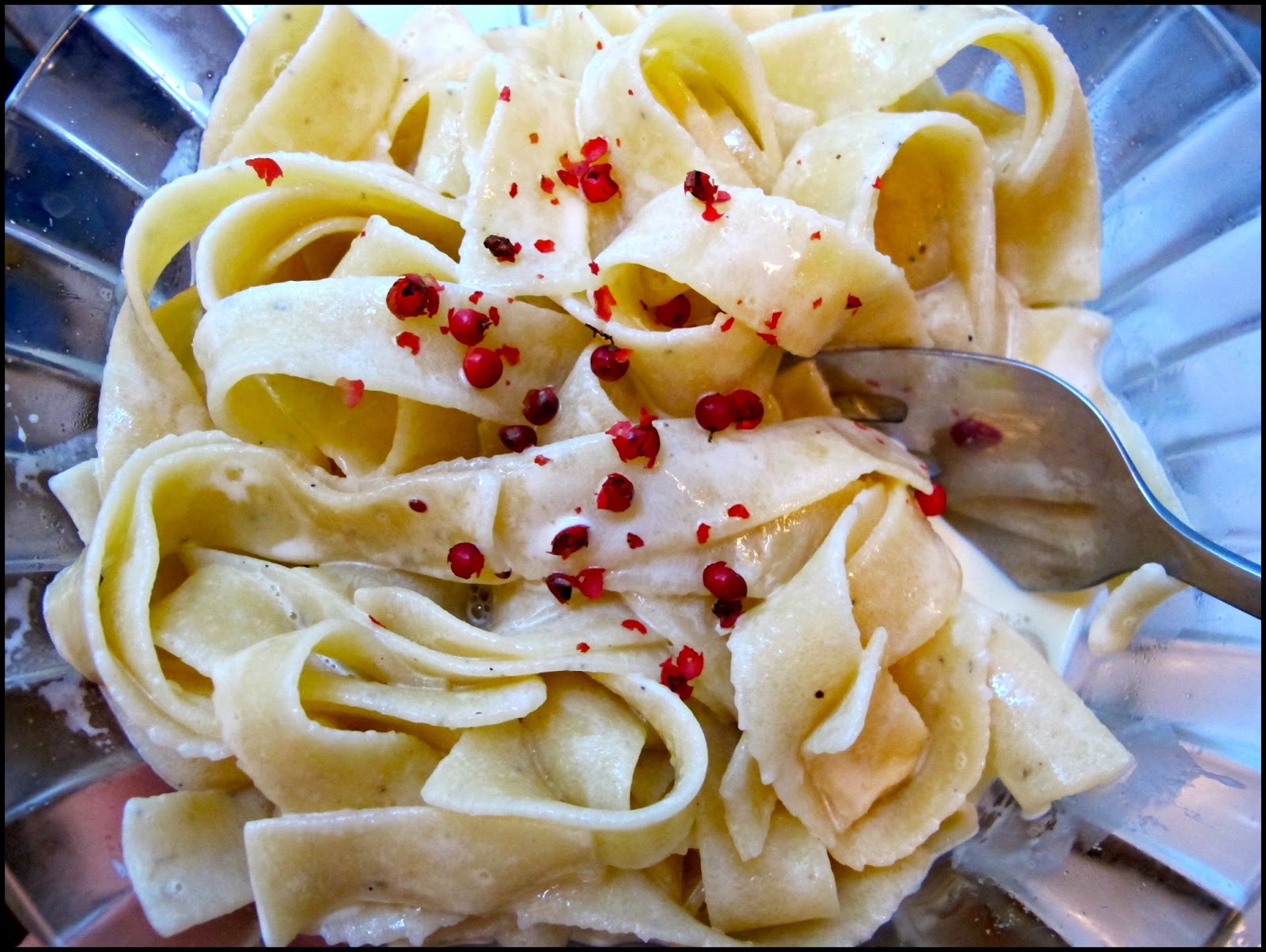
Truffle tagliatelli and pink peppercorns.
Never mind, we do have a canning demonstration/workshop and jar meal set for next year. On March 3rd, we have the hugely talented and probably only British expert on pressure canning, Gloria Nicol of The Laundry, coming down to London to teach. We will go through pressure canning, water bath canning and preserving. Jars will be provided by Le Parfait (love their jars). Gloria and I will then make a stunning supper, using our home-canned goodies, all in jars.
March 3rd 2013: Sunday, starts at 2pm. Book here: £60 for workshop and supper. Bring your own alcohol.